Managed Firewall vs Antivirus: What SMEs Need to Know
Firewalls and antivirus tools protect different layers. Learn what each one does, why mixing them up is costly, and what SMEs actually need.
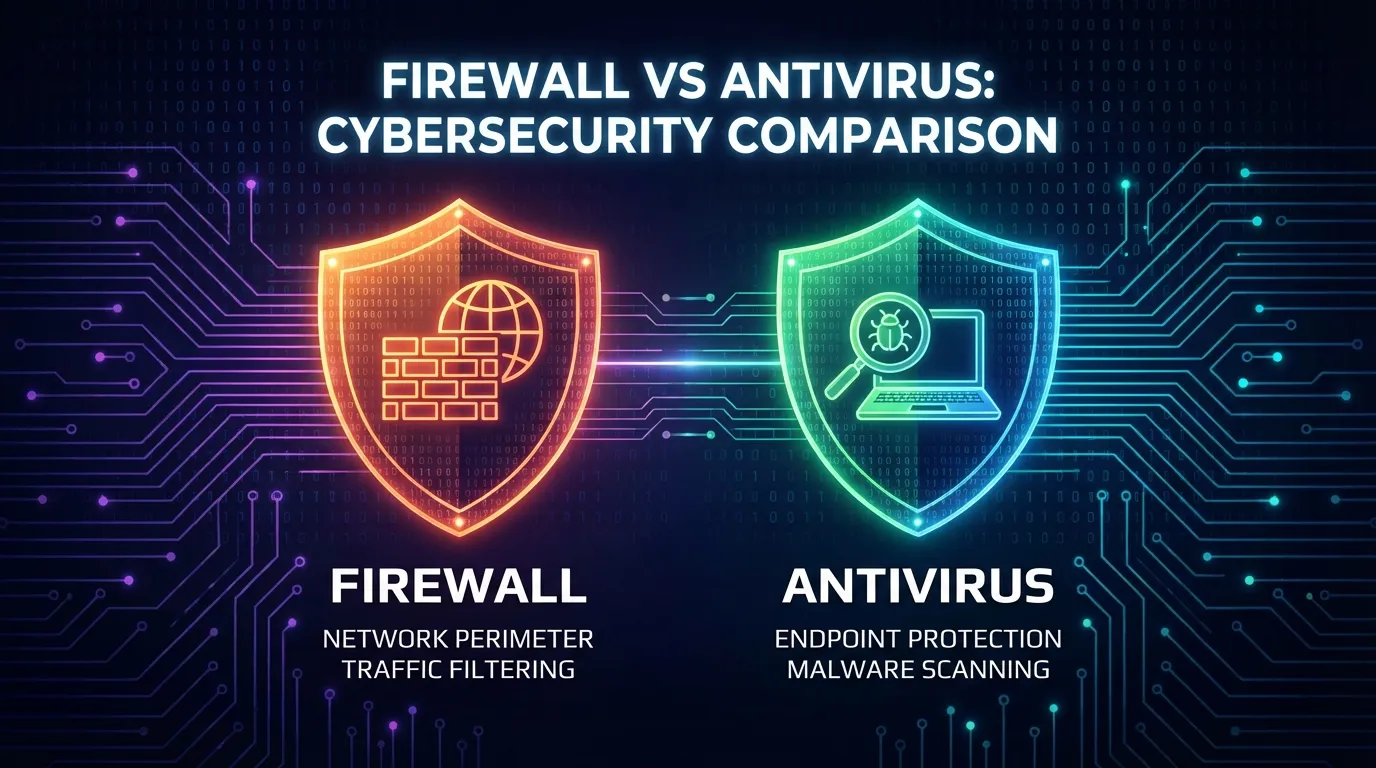
One of the most common misunderstandings in SME cybersecurity is the idea that antivirus protection and perimeter protection are basically the same thing. They are not.
Antivirus protects endpoints. Firewalls control network traffic. A managed firewall adds ongoing operation, visibility, and policy control around that traffic layer.
What antivirus does well
Antivirus or modern endpoint protection is designed to detect suspicious files, processes, and behaviors on individual devices. It is useful for:
- malware detection
- malicious file blocking
- endpoint behavior monitoring
- local response actions on the device
It is an endpoint control, not a perimeter control.
What a firewall does well
A firewall controls which traffic is allowed into and out of a network or segment. A modern firewall can help with:
- limiting exposed services
- filtering network traffic
- controlling admin paths
- reducing attack surface
- separating sensitive systems
It works at a different layer from antivirus.
Why the distinction matters
If attackers brute-force an exposed RDP service, the antivirus on the endpoint may not stop the initial access. If a malicious attachment lands on a user laptop, the firewall alone may not stop execution on that device.
That is why the two controls complement each other rather than replace each other.
Why managed firewall services change the equation
A self-managed firewall can still be badly configured, poorly maintained, or simply ignored. A managed firewall improves that by adding:
- rule review
- update handling
- structured visibility
- support around urgent changes
- clearer evidence for audits and reviews
The technical layer becomes more reliable because the operating layer improves.
What SMEs usually need
For most SMEs, the right baseline is:
- endpoint protection on user and server systems
- controlled perimeter security
- VPN and MFA for remote access
- centralized logging for key events
Trying to solve everything with only antivirus leaves the network layer too exposed. Trying to solve everything with only a firewall leaves the endpoint layer too weak.
Conclusion
Antivirus and managed firewalls do different jobs. A professional security posture needs both endpoint and perimeter controls, each operated consistently.
The expensive mistake is not choosing one over the other. It is assuming one can do the work of both.